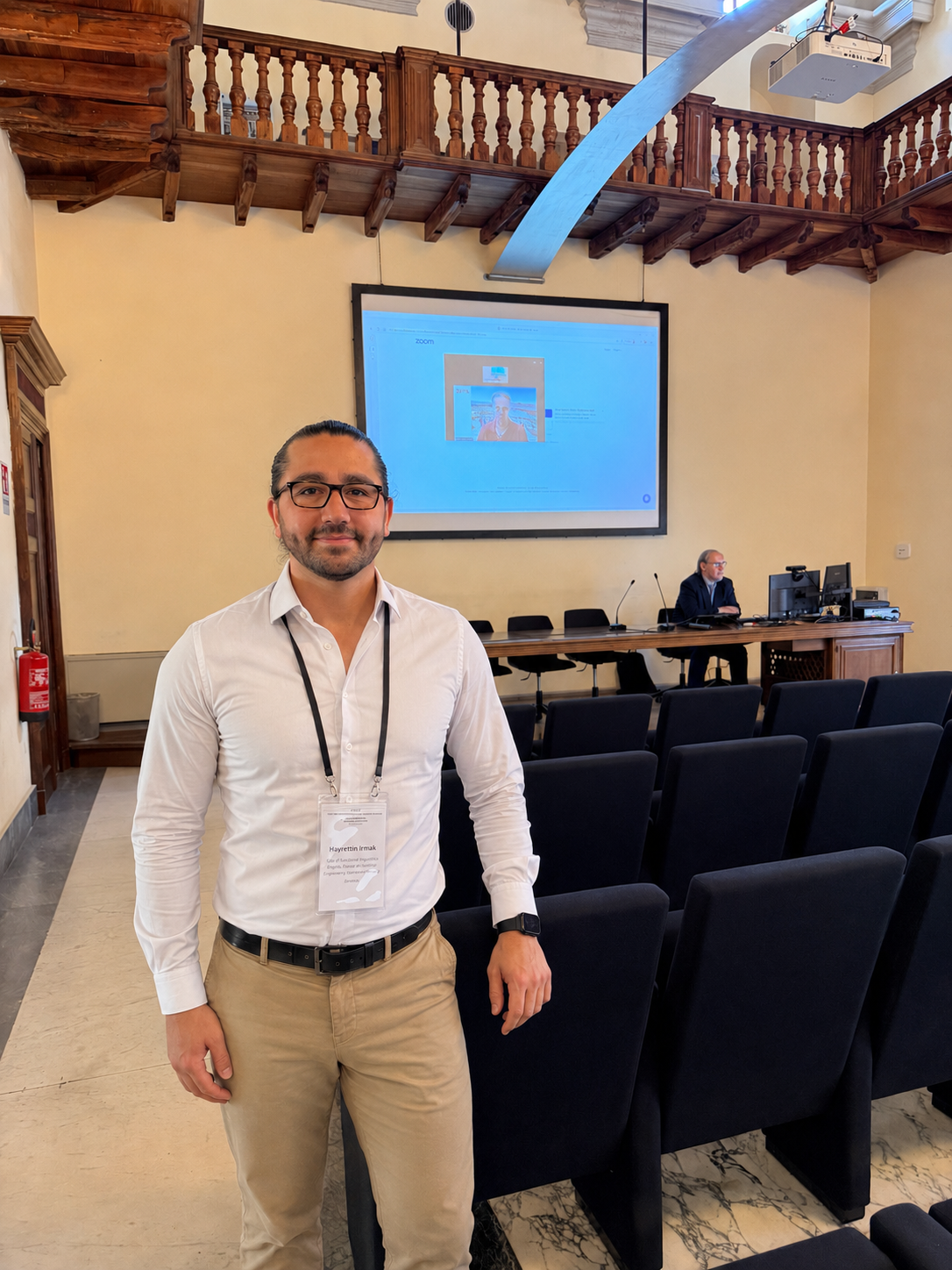
One of our research associates represented the Chair of Automotive Lightweight Design at two international scientific conferences in June and presented current research on fibre-reinforced metal–polymer hybrid structures. The focus was particularly on the analysis of manufacturing-induced residual stresses and deformations as well as their targeted reduction through fibre prestressing. The conferences also provided an opportunity to discuss current research questions and developments in the field of hybrid lightweight design with an international scientific audience.
From June 22–26, the 29th International Conference on Composite Structures (ICCS29) took place in Cagliari, Italy. The international conference brings together researchers from different areas of composite materials and composite structures to exchange ideas on current scientific developments as well as new experimental and numerical approaches. The range of main topics included the development and design of composite structures, experimental methods, advanced numerical techniques, the analysis of damage, failure and durability. Among the additional topics presented at the conference were multi-scale analysis, joints, and sustainable, recyclable and recycled composite materials. Hayrettin Irmak, one of our research associates, was also on site and gave a presentation titled “Analysis of the effect of fibre-prestressing on residual stresses in CFRP/steel hybrid components using a micromechanics-based finite element simulation with a dehomogenization method.” The presentation introduced a multiscale simulation approach for analysing process-induced residual stresses in CFRP/steel hybrid structures. In the first phase of the study, the curing and cooling process was simulated at the level of the fibre-matrix microstructure. The material properties determined from this analysis were subsequently transferred to a model of the hybrid laminate. The simulations showed that targeted fibre-prestressing can significantly reduce not only the residual stresses at the interface between CFRP and steel materials but also the process-induced laminate deflection. A dehomogenization method was also used to investigate how the macroscopic deformation state affects the local stresses in the fibres and matrix.
At almost the same time, from June 23–25, the international symposium “Residual Stress in Materials Science and Engineering” (RSMSE 2026) was held as a hybrid event in Kassel and online. The conference focuses on the development of the characterization and modelling of residual stresses in materials and components, bringing together experts from academy and industry to exchange ideas on measurement methods, simulations and the control of residual stresses. Hayrettin Irmak participated online and gave a presentation titled “The investigation of residual stress distribution in metal-CFRP hybrid structures produced by the developed fiber pre-tensioning tool concept.” The presentation introduced a tool concept developed at the Chair of Automotive Lightweight Design for manufacturing fibre-prestressed CFRP/steel hybrid structures. A reference configuration without fibre-prestressing and two configurations with different fibre-prestressing levels were investigated. Another focus was the numerical simulation of the simultaneous curing and hybridization process, which was used to analyse the resulting residual stresses and process-induced laminate deflection. Finally, the calculated residual stress distributions were compared with the experimental results obtained using the incremental hole drilling method.
By participating in both conferences, LiA was able to present its current research on the manufacturing and design of metal-CFRP hybrid structures to an international specialist audience. At the same time, the events provided an opportunity for scientific exchange on new methods and developments in the fields of composite materials and residual stress analysis.
Link to ICCS29: events.unibo.it/iccs/
Link to RSMSE 2026: dgm.de/rsmse/2026