Ultrasonic powder conveyance
The transport of ultrafine powders with particle sizes of just a few micrometres presents a technological challenge. Due to the adhesive forces of ultrafine powders, conventional transport mechanisms such as vibratory conveyors fail.
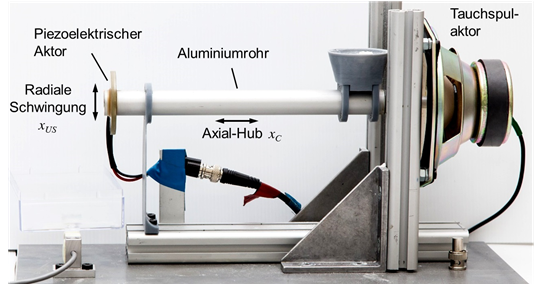
A relatively new principle for conveying these fine powders is based on ultrasonic vibrations, which are used to reduce the effective coefficient of friction between the powder and the substrate. The conveying medium (e.g. a pipe or trough) is excited by an actuator to produce a low-frequency, harmonic vibration in the direction of transport. By coordinating the activation and deactivation of an additional ultrasonic vibration, the effective coefficient of friction between the powder and the conveying medium is manipulated in such a way that the powder is strongly accelerated in one direction (where the effective coefficient of friction is high) and only slightly decelerated in the other (where the effective coefficient of friction is reduced). A sequence of such vibration periods enables continuous powder transport.
This operating principle is suitable for both large powder flows and precise dosing. A model was developed to determine the appropriate operating parameters in each case (amplitudes of the movements, switching timing, election of pipe material). This enables, for example, the targeted maximisation of the conveying speed by setting optimised switching points.
You can find publications on powder transport here.