Ultrasonic thick-wire bonding
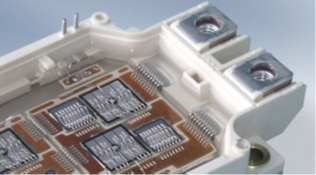
Ultrasonic thick-wire bonding is a bonding technique widely used in the semiconductor industry. It involves the use of wires with a diameter of between 75 μm and 600 μm to bond, for example, IGBT chips in high-power modules. Such modules are used, amongst other things, in the power supply systems of industrial electric drives and electric cars, and in the renewable energy sector in wind turbines and solar power plants.
The bonding process takes place in four phases: first, the wire is pre-deformed by the ‘touchdown force’; then, the ultrasonic vibration of the bonding tool cleans and levels the joint zone until the first micro-welds form. The ultrasonic energy exerts a high shear stress on the wire, causing it to deform disproportionately (the ‘ultrasonic softening’ effect). Finally, as the surfaces approach one another, interdiffusion between the wire and the substrate occurs, along with plastic flow of the materials. Without the additional introduction of heat, a bond with intermetallic bonding is formed between the wire and the substrate. Ultrasonic thick-wire bonding is therefore suitable for joining dissimilar metals without subjecting surrounding components to thermal stress.
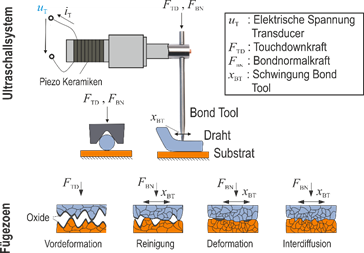
Many factors, such as the ultrasonic amplitude, the excitation frequency, the normal forces and the duration of ultrasonic coupling, have a significant influence on the resulting bond quality; this is most commonly determined using destructive testing methods (shear or pull tests) and expressed as joint strength. The interaction between these influencing factors is highly complex and has not yet been fully investigated. For this reason, experimental investigations and the simulation of the bonding process are key areas of current research and development in ultrasonic thick-wire bonding, with the aim of developing and optimising new processes using larger wire diameters and new material combinations. This also includes the development of new technologies such as multidimensional bonding and the geometric optimisation of bonding tools.
Publications by the Chair on this area of research can be found here.