Predicting the service life of technical systems, taking non-stationary operating conditions into account
In traditional condition monitoring, it is assumed that the operating conditions throughout the life cycle of a technical system are known a priori and are steady-state, i.e. constant or periodic. These assumptions simplify the implementation of condition monitoring in various respects. For example, when diagnosing rolling bearing damage – that is, identifying the current state of damage and determining which rolling bearing component is damaged – the damage frequencies can be calculated or analysed in relation to the (constant) rotational speed or frequency. In the case of prognosis, the current trend can then be extrapolated into the future using suitable methods.
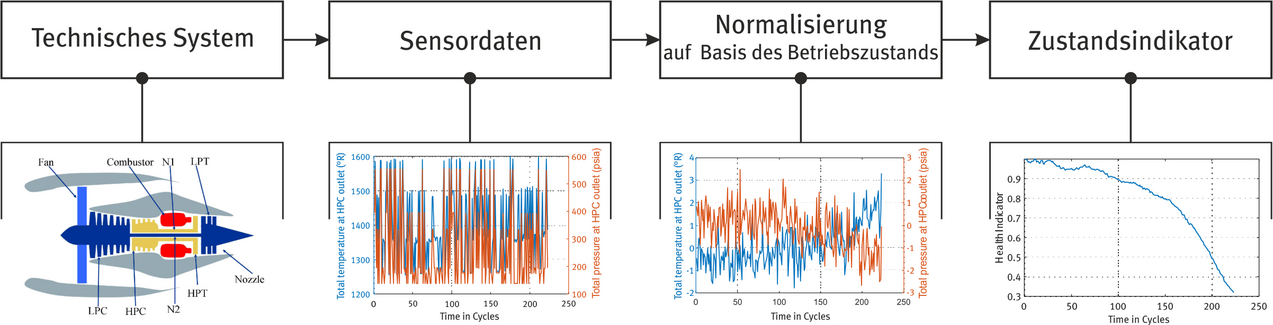
However, many technical systems are operated under non-stationary, i.e. stochastic or discrete, conditions, which need not be known a priori. In a production line, for example, where different components must be manufactured under varying operating conditions, the required clamping force during joining assumes discrete states due to the different material properties of the components. This non-stationary nature is reflected in the recorded measurement data; that is, changes caused by friction and wear are superimposed by varying operating conditions. This can pose particular challenges for the condition monitoring algorithms to be implemented and is the subject of current research.