Defined residual stress setting for friction-assisted spinning and flow-forming
Overview
Funding institution:
German Research Foundation (DFG) - Project number 410908773
Description:
Today, forming technology is often the key to the efficient and resource-saving production of innovative, novel products with high utility value. In order to realise high degrees of forming and thus the best possible utilisation of the material, new approaches are being researched and existing processes further developed.
The "friction spinning" process was developed with the aim of expanding and improving the processes and results of spinning processes through the synergetic combination of process elements from the fields of friction welding and spinning. The integration of thermomechanical sub-processes into the spinning process has achieved promising results in terms of microstructure and hardness influence on various steel and aluminium alloys.
Thus, a new, innovative group of complex multifunctional components, such as hollow metallic workpieces, with locally graded properties adapted to requirements can be produced from tubular, profiled or sheet metal semi-finished products. The self-induced partial heating of the components through the process-integrated friction processes not only enables much greater deformation, but also a defined influence on the mechanical properties and microstructures.
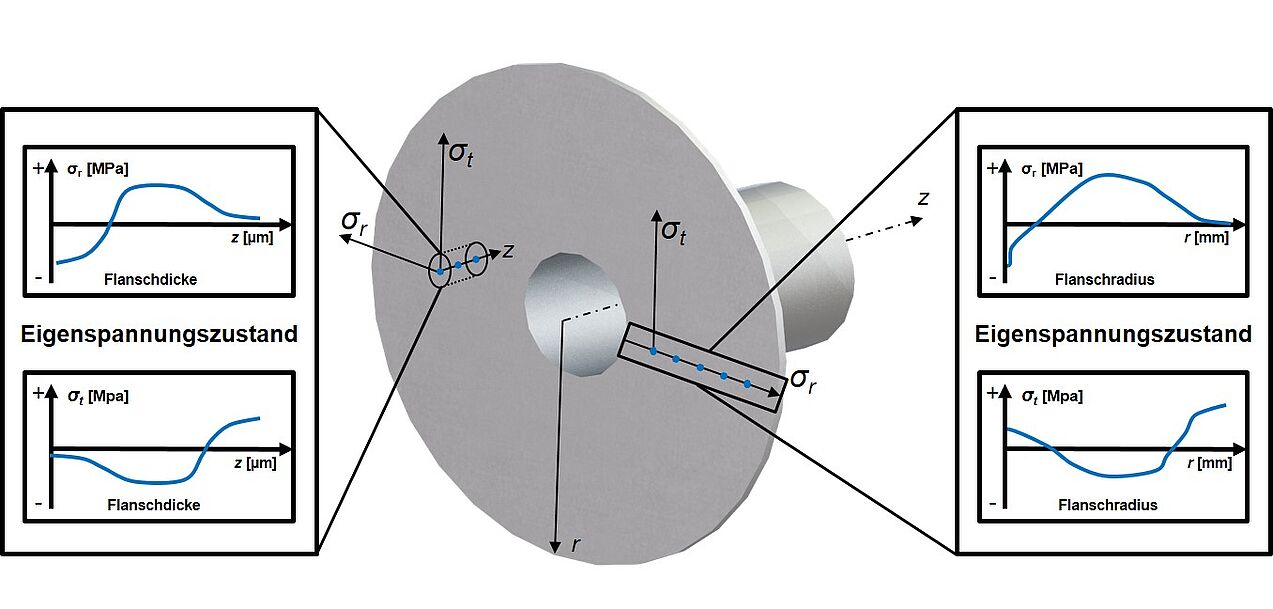
The aim of the project is to expand friction spinning on the basis of fundamental investigations with regard to the production of high-performance components, such as lightweight shafts and bolts for aerospace technology with defined residual stress states. The locally adapted residual stress distributions generated in this way are intended to improve component quality and functionality, for example by delaying failure
or bringing it about in a defined manner.