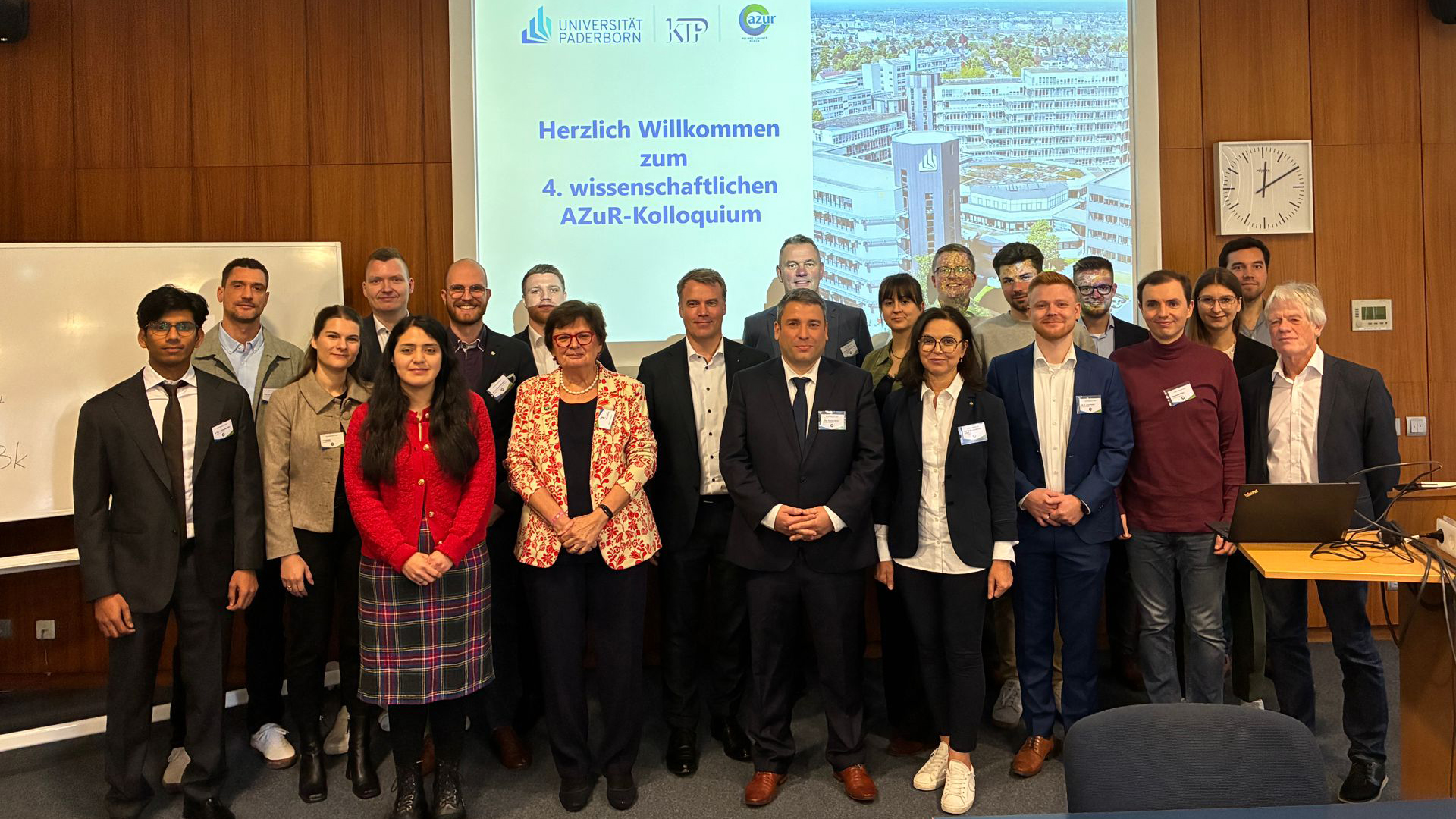
Paderborn/Willich, 5 November 2025 On 29 October 2025, 25 researchers from all over Germany met at the invitation of the Future Tyre Alliance for the fourth AZuR scientific colloquium at Paderborn University's Paderborn Plastics Technology (KTP). Under the motto "Fresh impetus for the circular tyre economy", the scientists exchanged views on current research projects and studies relating to the sustainable recycling and reuse of used tyres. With seven specialist presentations and intensive debates, the event in Paderborn was a valuable platform for new, interdisciplinary cooperation.
Prof. Dr.-Ing. Elmar Morbitzer from the KTP welcomed 25 participants from universities and research institutions from all over Germany. AZuR coordinator Christina Guth and Stefan Rau (wdk) expressed their sincere thanks for the organisation and hospitality: "We are delighted to have a strong partner for applied research in our network in the KTP." The colloquium focused on seven in-depth specialist presentations from various disciplines - from mechanical processing, pyrolysis and devulcanisation to digitalisation and environmental research.
Exciting research impulses from all over Germany
Andreas Glimm (Nordhausen University of Applied Sciences) kicked things off with a presentation on the mechanical processing of various waste materials and their material utilisation in pyrolysis. Sebastian Bogdahn (TH Köln:metabolon Institute) then presented new findings on the life cycle assessment of carbonisates from waste tyre pyrolysis.
The presentation by Prof. Dr. Carmen-Simona Jordan (Osnabrück University of Applied Sciences), who showed how the properties of recycled EPDM materials can be specifically improved through liquid polymer activation, also met with great interest. Jonas Petzke (Paderborn University) followed on from this with his analysis of the thermo-chemical devulcanisation behaviour of SBR-based GTR compounds and emphasised the relevance of industrial issues for research: "We welcome it when industry approaches us with specific tasks - we develop the right solutions for them here. We would like to invite the AZuR partners to approach us with further exciting tasks."
Digital change was also discussed at the colloquium: Paul Szabó-Müller (Ruhr West University of Applied Sciences) presented innovative concepts for promoting the circular economy through digitalisation. Angus Rocha Vogel (Helmholtz Centre for Environmental Research) shed light on environmentally relevant aspects with an investigation into the potential environmental impact of tyre abrasion in rivers. Florian Löhr (Paderborn University) concluded the series of lectures with a highly relevant contribution on the direct adhesion of thermosets and rubber in the 2K injection moulding process - a development that could replace adhesives in production.
Constructive exchange, practical transfer and outlook
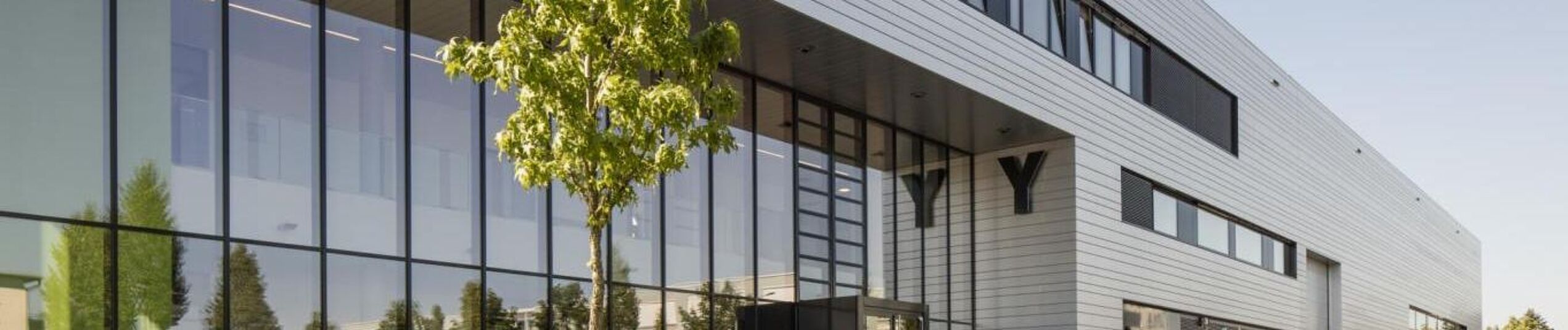
In addition to the technical presentations, the colloquium offered participants exciting insights behind the scenes at the KTP. During a guided tour of the KTP's technical centre, participants were able to experience current research institutions and test benches up close. The modern laboratories provided space for professional dialogue - and sparked interest in joint projects. The open and interdisciplinary atmosphere at the KTP Paderborn encouraged intensive dialogue between the subject areas and laid the foundation for new, forward-looking collaborations - a central goal of the colloquium.
The AZuR scientific colloquium has established itself as a permanent fixture in the network. It brings together experts from a wide range of disciplines, promotes knowledge transfer and creates links between research, industry and practice. AZuR Coordinator Christina Guth summarises: "A functioning circular economy needs strong impetus from science - and science needs practice in order to have an impact. Only together can we shape the transition to a genuine circular economy."
With events such as the colloquium, AZuR succeeds in making innovative solutions visible, promoting interdisciplinary dialogue and strengthening the network for future challenges. The next AZuR scientific colloquium will take place on 28/29 October 2026 at Nordhausen University of Applied Sciences.
About the Alliance for the Future of Tyres (AZuR)
AZuR has been committed to a sustainable tyre circular economy throughout Europe since 2020. Used tyres should be 100 percent reused or recycled wherever possible in order to avoid waste, reduce CO2 emissions, conserve natural resources and protect people and the environment.
More than 90 AZuR partners from industry, trade and science cover all sectors of the sustainable circular economy of tyres - from the sustainable production of new tyres and certified collection of used tyres to the repair and retreading of car and commercial vehicle tyres and the material and chemical recycling of the raw materials contained in used tyres.
New approaches and solutions for an ecologically and economically sensible tyre cycle are developed in interdisciplinary teamwork. The universities in the AZuR network play a particularly important role here. With their scientifically sound studies and research, they provide valuable impetus for closing the material cycle.
The Future Tyre Alliance was awarded the "European Transport Prize for Sustainability 2024" for its study on the positive life cycle assessment of retreading. AZuR network coordinator Christina Guth was honoured with the Recircle Award 2025 in the Women's Award for the Tyre Retreading Sector category. You can find out more about AZuR here: https://azur-netzwerk.de