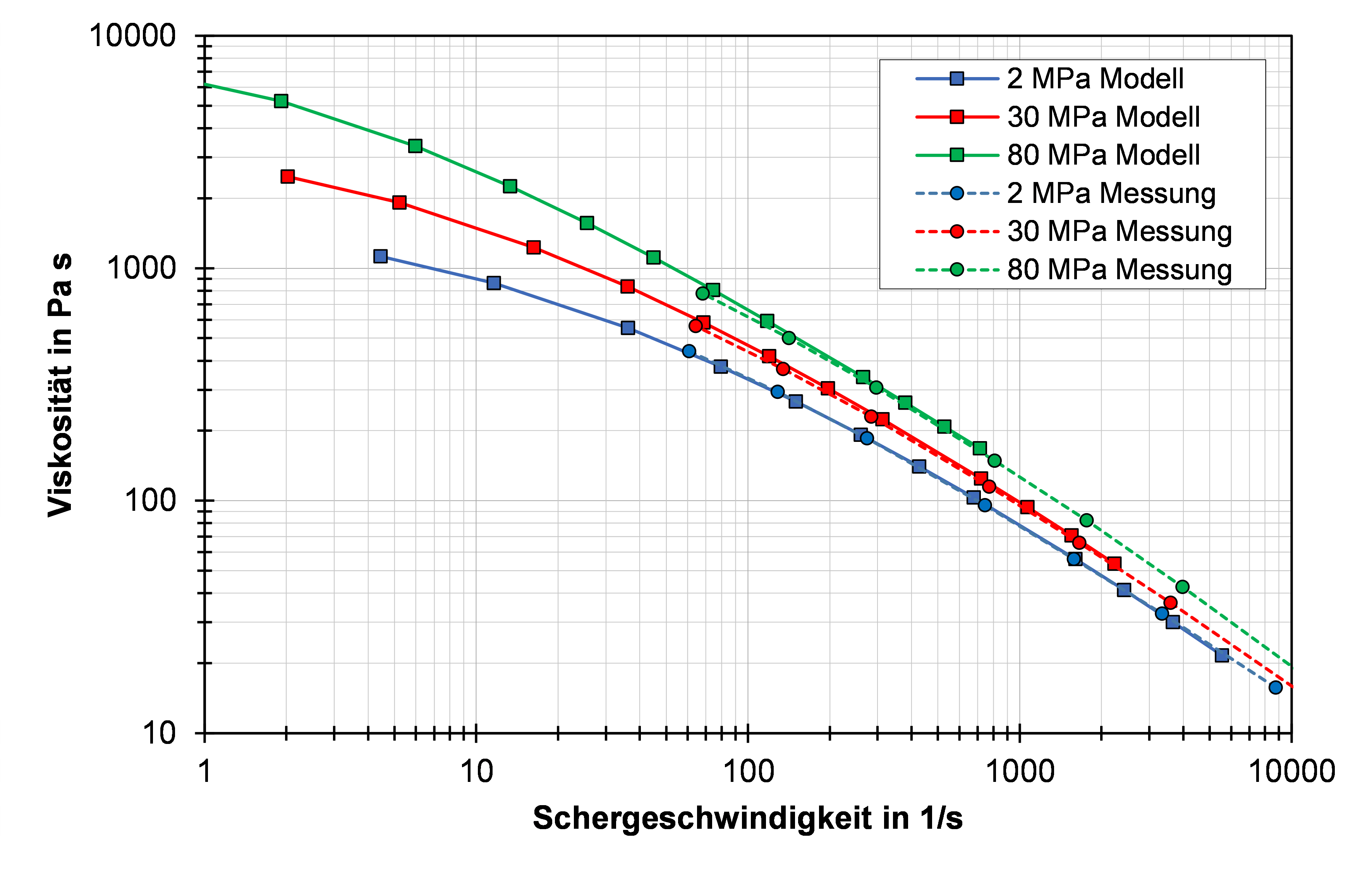
The viscosity of the materials used is a key input variable for the simulation-based design of plastics processing methods, particularly in injection moulding and extrusion. While temperature and shear rate-dependent viscosity data are determined as standard using high-pressure capillary rheometers (HPCR), the pressure dependence is often neglected in industrial practice. The reason for this is the high equipment costs and the limited resources available for pressure-variable viscosity measurements, for example using back-pressure viscometers or back-pressure chambers.
The aim of the IGF research project was therefore to develop a model to describe viscosity as a function of temperature, shear rate and, in particular, pressure, using only conventionally available rheological data and pvT measurements as a basis. The modelling is based on the free volume approach, which allows a correlation between viscosity and the specific volume of the polymer.
Different amorphous and semi-crystalline thermoplastic polymers (PP, LDPE, HDPE, PC, PS, ABS) were analysed as part of the project. The materials were selected in consultation with the project committee, taking into account their practical relevance in extrusion and injection moulding. Isothermal and isobaric pvT measurements as well as conventional HKR measurements were carried out for the materials. In addition, exemplary thermographic infrared images were taken to record shear dissipative heating during the HKR measurement and their influence on the viscosity was analysed.
To validate the developed model, pressure-dependent viscosity data were determined experimentally using an HKR with an additional back pressure chamber and compared with the model-based generated data. The results show a high level of agreement, meaning that the pressure dependence can be reliably described for the analysed materials without having to use additional measurement setups.
For practical application, the model was transferred to a Python-based software tool. The application is reproducible and requires minimal manual effort. On the basis of the newly generated viscosity data, simulations can be carried out taking into account the pressure dependence of the viscosity.
The effects of taking the pressure dependency of viscosity into account were also evaluated using hot runner simulations. Compared to conventional viscosity approaches, a significantly higher simulated injection pressure was found, especially for amorphous plastics, which indicates a more realistic representation of the process conditions. In cooperation with ARBURG GmbH + Co KG and Barnes Group Inc., comparative experimental injection moulding tests were carried out, which confirmed an improvement in simulation accuracy.
A final economic analysis showed that the developed process represents a cost-efficient alternative to direct measurements. It enables an increase in data quality with a simultaneous reduction in measurement effort and investment costs, which can be a significant advantage, especially for SMEs with limited resources in the field of rheological measurement technology.
The detailed final report of the IGF project no. 01IF22496N can be obtained from the Forschungskuratorium Maschinenbau (FKM) e. V. (postal address: Lyoner Str. 18, 60528 Frankfurt am Main, e-mail: info@fkm-net.de, phone: +49 69 6603 1352).