Mas­ter pro­gram

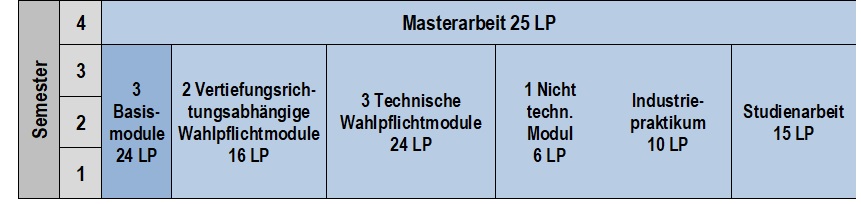
The four-semester master program consists of an industrial internship, a student research project and the master thesis. The whole program offers various options in terms of courses. Students can determine their individual academic profile by choosing a personal area of concentration and selecting a specialisation with its’ involved basic modules.


At the beginning of each semester, lecturers will inform you about how the course is designed, questions concerning the course content and examination methods/ audit fields. Precise details of  courses can be found on PAUL on the tab courses. Courses take place in form of lectures, practical seminars, seminars/ project seminars, study trips and internships.

Offered courses:

Lecture: Lectures will introduce you to the subject and systematically provide you with the requested knowledge via oral presentations.

Practical seminars: Practical seminars allow you to delve deeper into special topics with the help of application examples, further explanations and independent practice.

Seminars and project seminars: A branch of one or more subjects is being compiled, extended and reinforced.

Internships: Are important to recall conveyed knowledge via experiments.

Exams take place either in written or oral form, often within the scope of seminars.

Written exams last up to four hours, whereas oral exams may be offered in form of group or single exams and take from 30 up to 45 minutes. Handing in a written presentation, holding an oral lecture and through active participation may exams within the scope of some seminars be passed.

By choosing a specialisation, three basic modules are defined. Within these basic modules, two courses with a specified total of 8 credit points must be completed. The following specialisations can be chosen in the specialisation programme:
Energy and Process Engineering, Plastics Engineering, Mechatronics, Product Development, Production Engineering, Lightweight Construction with Hybrid Systems, Material Properties and Simulation, Engineering Informatics and Automotive Engineering.

Each basic module consists of two compulsory courses, each worth 4 credit points. The current version of the module handbook for the Bachelor's degree programme in Mechanical Engineering can be found here.

In the compulsory elective module, two courses with a fixed total of eight credit points must be selected from a catalogue of modules and completed. Students should be given the opportunity to create a personal profile through their choice.

A compulsory elective module consists of courses on a subject area described by the title of the module. The basic modules from the specialisations are listed here and can also be selected as compulsory elective modules if they have not already been selected as basic modules.

Students who begin their Master's degree programme in the 2018/2019 winter semester must complete a 10-week compulsory internship, which is credited with 10 credit points in the degree programme (ungraded).

The aim of the internship is to provide students with exemplary knowledge of the processes of operational practice and to give them an insight into the organisation and working methods of industrial production. An important aspect of the work placement is also to understand the social environment of the company. Students should understand the company in which they work as a social structure, familiarise themselves in particular with the relationship between managers and employees and expand their social skills.

The internship should be completed during the lecture-free period of the Master's programme. Proof of the complete internship must be provided and recognised by the Internship Office before registering for the Master's thesis. The content of the internship and the student work to be completed in the Master's programme (student research project, Master's thesis) must be different. When submitting the internship report, the student must submit a signed declaration stating that there are no thematic overlaps with the student research project or Master's thesis.

The internship is characterised by: Integration of the intern into the working environment of engineers or appropriately qualified persons with a predominantly developing, planning or directing activity character. Further information on internships can be found on the website of the <link fakultaet/organisation/praktikantenamt/>Praktikantenamts.

The student research project is an examination paper which is intended to deepen the knowledge acquired in the Master's programme and prepare students for the Master's thesis. The workload for the written part of the coursework is 12 credit points and 3 credit points for the associated colloquium. The written part of the coursework comprises 360 hours of work and must be completed within a period of 6 months. There are no restrictions for admission to the coursework in the Master's degree programme; it can theoretically be started in the first Master's semester.

The Master's thesis is the final examination paper of the degree programme and is completed in the final semester. It should show that the student is able to work independently on a problem from the subject area using scientific methods within a given period of time. The workload for the written part of the Master's thesis is 22 credit points and 3 credit points for the associated colloquium. The written part of the Master's thesis comprises 660 hours of work and must be completed within a period of 6 months.